

Share this Post
Zen Buddhism Diploma Course
Original price was: £295.00.£225.00Current price is: £225.00.
Course Overview (Sale Price)
Registered Open College Diploma Course
- SFTR Accredited Open College Diploma Certificate Course
- Upon completion of this course, you will be entitled to the use of these Designatory letters after your name: Zen.Buddhism.Studies.dip which will be printed upon your final Diploma Certificate under your name.
Additionally, you will receive these 2 Certificates within your course package:
- A4 size Membership wall display certificate into the Open College. Allowing you the use of MOC after your name.
- A4 size Membership wall display certificate into the SFTR. Allowing you the use of MSFTR after your name.
This Certificate course is currently available for the temporary reduced low fee of only £225.00
Course Description
Zen Buddhism Diploma Studies Course
Q: What will this Zen Buddhism course teach me?
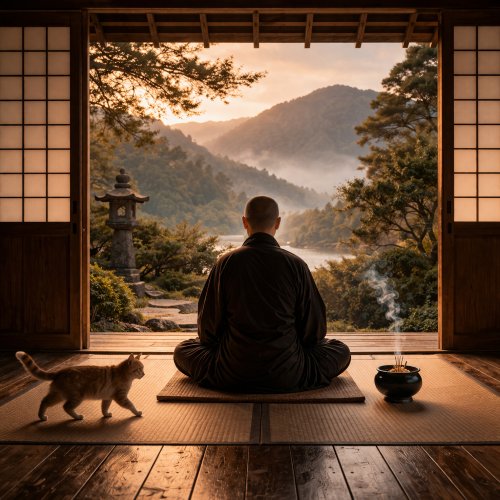
A: This course introduces you to the CORRECT practice of Zen, guiding beginners through sitting, breathing and integrating mindfulness (noticing) into everyday life while gently unfolding the path ahead, toward deeper understanding and eventually direct seeing.
Zen can be introduced into everybody’s life in part and no more! For others, Zen becomes a true clean way of life. Where people privately and quietly become practitioners and introduce the practise into their everyday living on how to be.
Most people at this stage are called seekers. YOU are seeking.
Once Kensho is experienced, life changes and the serious practitioner sees and understands and cannot say, then lives a settled and simple integrated life deepening and practising daily.
For the serious deepening practitioner, Zen is simplifying their life by deconstructing the self and ego through continued practise. Prior to death you become available, cleaned, honest, decent and knowing but cannot say. Zen calls this pure witnessing and arrived!
Zen does not take a stance on religion, gods, the afterlife or theism and atheism. It does not dismiss either. What Zen teaches is a practice, a way to step outside the thinking, conceptual mind to see the truth.
Through this daily sitting, walking and working meditation practice, the aim is to eventually directly experience reality, nature and this life phenomena we live in, as it truly is and not how language says it is. It is not about belief, but about seeing for oneself. Direct seeing, pure witnessing!
The serious Zen practitioner will eventually penetrate and pierce, that which the average non practitioner cannot see or know, to have a direct experience of that which is not within, language, description or experience.
This introductory Zen Buddhism course offers a practical and profound approach to meditation and mindful living. Students will learn how to sit comfortably, focus on the breath and cultivate a steady present awareness. This course emphasizes bringing Zen into daily activities, making the practice accessible for novices and beginners. Over time, the course shows how consistent practice can deepen understanding, supporting a more experienced approach to meditation and insight – seeing.
As the path unfolds, students explore subtle aspects of Zen, moving gradually beyond concepts and language, toward direct seeing of reality as it is. This course encourages patience, respect, and curiosity, helping learners to develop a steady practice that grows naturally over time. By guiding participants through both foundational exercises and deeper contemplative techniques, it offers a balanced path from beginner awareness to a more experienced and refined understanding of Zen.
Anyone is welcome to enrol onto this course, complete beginners or intermediates.
Further reading on what threading the Zen path offers you as a practitioner!
Welcome to Zen!
Zen Buddhism does not offer a final map or conceptual blueprint of reality.
It does not declare that God exists or does not exist. It does not promise or deny anything. It does not affirm or reject spiritual realms, dimensions, or extraterrestrial beings. Zen remains silent on ALL these questions, quietly leaving space for direct experience rather than conceptual certainty.
At the same time, Zen practice can align naturally with observations from mainstream science, biology, chemistry, physics, psychology and quantum mechanics without claiming authority over them. These disciplines like religions and philosophies are hard attempts to map the phenomena of what this life is and this consciousness. They are products of the mind, built from language, ego and conceptual thinking TO SURVIVE THIS REALM. They help navigate existence but they are ultimately overlays, not reality itself.
A tree is not a tree; it is a word. And that word is describing itself, language describing itself and so on, lost within a loop where you will spin. So, if it is not a tree, what is it? It can’t be described; it can only be seen and experienced.
A word/language (vibration or sound) is a representation of the tree. The object we call tree is phenomena and that can’t be described.
Zen practise penetrates this!
You cannot see pure reality because you are locked into a language structure and ego which developed from early childhood.
You use words to describe this phenomenon, this reality.
Your thinking is in the way.
Your ‘SELF’ is in the way.
Your belief structure is in the way.
Your subconscious fears of death are in the way.
Your intelligence and logical, analytical thinking are in the way.
Your thinking and VIEWS are in the way.
All thinking, ideas that the human mind, creates and throws up, are ‘VIEWS’ and stops you from seeing the non-conceptual. The non-conceptual cannot be described in language or words and can only be – experienced – seen.
Daily meditative practise will eventually take you to what is called Kensho, where all of this structure will collapse.
Zen practise deconstructs this and its attachments through daily meditative practise.
From the beginner’s viewpoint, this can be startling. We are drawn to create, analyse and dissect, endlessly expanding our maps of belief, knowledge and meaning. No matter how sophisticated these maps are or appear, they only skim the surface or represent what this is, this that we live in, this ‘phenomena’ that we are part of, this dimension, this matter, this experience – life.
Reality, immediate and raw, remains untouched by thought and language. That which is not this, is ungraspable with the conceptual thinking mind and Zen has been telling you this for over 1,000 years and other schools of Buddhism for over 2,000 years.
Zen practice invites a different path. Through sitting, breathing and mindful attention, the practitioner gradually steps outside of the conceptual mind, beyond ego, beyond language, beyond maps into direct seeing. This is pure witnessing, the essence of liberation, the heart of Zen. At this point, ideas of religion, science, or philosophy are seen as just that VIEWS: beautiful, intricate stories spun by the fearful mind. From a Zen perspective, they are like a leaf rattling on a poplar tree, noise, real in appearance but optional in truth.
The beginner begins here, drawn by the promise of understanding and freedom. Along the path, through consistent practice, patience and reflection, the mind slowly loosens its grip on conceptual thinking. Gradually, one learns to see clearly, not through maps, not through words, language, ideas, theories or beliefs but directly. Zen doesn’t give the answer; it opens the door to you – experiencing it for yourself.
Buddhism has always said – Go see for yourself!
Zen points the finger and shows you the way but you have to travel the path and put the work in.
Further along the path. A serious practitioner will slowly deconstruct the selfish ego and stop lying to oneself and develop authenticity and decency.
Many practitioners at this stage, live on clean healthy wholesome food and do not eat animals. They do not cause’ suffering or distress to any living beings of any kind, not even insects. Experience at times depths of love, compassion, kindness, mercy and forgiveness for all beings.
Have cleaned their past, done their own internal healing, shadow work, found honesty and lost all performative show, display in all parts of their ego and live cleanly in this moment, settled and integrated in a simple, noticing, deepening life with a knowing and understanding that cannot be shared or explained to others.
Zen practitioners take a position in life of putting others first and themselves second. Practise leads to ego-lessness and selflessness with a silent non show.
Ultimately, Zen leads to absolute truth.
Put the effort into your daily meditative practise and you will know!
Zen cannot abide by any unnecessary harm, suffering or causing distress to any living being. Zen is simple, clean and prepares you – to know and to become available at death.
Course Provider:
Open College UK Ltd
Format:
This course is set in the English language and is entirely coursework based. All notes and reading materials, including text book/s are supplied by us direct in one complete package. There are no other required text or materials, books to purchase. We supply everything for you within your course package for the low fee shown. There are no hidden or additional fees to pay.
Method of Learning:
This is a home study, distance learning course. All of your course study materials are posted to you in one complete study package. All of your coursework is to be completed within the outlined period. This course is structured in an EASY LEARNING and user-friendly way.
Objectives:
Upon completion of this home learning programme, students should be able to understand the basics of many key areas within this subject. Participants of the course will have acquired an overall basic understanding of the subject matter and will have achieved a sound basis to summarize important topics and be reasonably competent to make further progress and educational development in this field with a range of theoretical skills and insights to assist with any short- or long-term goals.
Grading Assessment:
This course is assessed upon the successful completion and submission of coursework with a Pass, Merit or Distinction. Distinction is 90%. All content is course work based, home study through the post or online, depending on the subject being studied. NO attendance or visits to any exam centre is required on this subject.
Entry Requirements:
There are NO entry requirements. No background training or qualifications are required. Anyone can enrol at any time, beginners, intermediates and experienced all year round. You are expected to be able to read and write or type/word process your coursework and be able to understand the English language.
Recently Viewed Products
-
 Clicker Training Diploma Course for Dogs
Original price was: £295.00.£225.00Current price is: £225.00.
Clicker Training Diploma Course for Dogs
Original price was: £295.00.£225.00Current price is: £225.00.
-
 Raising Chickens Diploma Course
Original price was: £325.00.£245.00Current price is: £245.00.
Raising Chickens Diploma Course
Original price was: £325.00.£245.00Current price is: £245.00.
Recent Reviews
-
 Counselling Theory Diploma Course
by Director
Counselling Theory Diploma Course
by Director

Reviews
There are no reviews yet.